# Bug Conspiracy
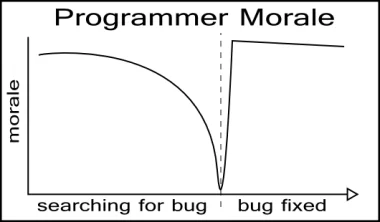
> There is a burst of energy that happens upon finding the source of an elusive bug, which is driving me to write this post.
**Date:** 2019-02-08
**Author:** Filipe Roque
**Tags:** Java, Wicket, Compiler, Eclipse, Bug-hunting
There is a burst of energy that happens upon finding the source of an elusive bug, which is driving me to write this post.
---
On a recent project, we used the [Apache Wicket](http://wicket.apache.org/) framework for the web interface. As the client also wanted a very simple REST API, we used the [Wicket REST annotations](https://github.com/wicketstuff/core/tree/master/wicketstuff-restannotations-parent) library from the [Wicket Stuff](http://wicketstuff.org/) project.
The project had an abstract base class `ResourceBase`, inherited by all endpoints:
```java
public abstract class ResourceBase extendsAbstractRestResource {
public ResourceBase(JsonWebSerialDeserial serialDeserial) {
super(serialDeserial);
}
public abstract T submit();
}
```
Here's one of the endpoints:
```java
public class LoginResource extends ResourceBase {
public LoginResource(JsonWebSerialDeserial serialDeserial) {
super(serialDeserial);
}
@Override
@MethodMapping(value = "/")
public IRestLoginDTO submit() {
return null;
}
}
```
The `IRestLoginDTO` interface extends `IDTOFrontEnd`:
```java
public interface IDTOFrontEnd extends IClusterable {
}
public interface IRestLoginDTO extends IDTOFrontEnd {
}
```
Everything worked OK in development, but when we deployed in pre-production, we suddenly got the following error when accessing the API:
Ambiguous methods mapped for the current request: `URL 'api/common/login', HTTP method GET. Mapped methods: submit`
Everything worked well in one of my colleagues' machine, but I was getting mixed results trying to reproduce the problem: sometimes it would work, and other times not, and I couldn't figure out why.
As I had recently squandered a great deal of time on an OpenJDK [bug](https://bugs.debian.org/cgi-bin/bugreport.cgi?bug=911925) that did not exist on Oracle JDK, I thought it might be the same type of thing, but I didn't know what exactly was happening.
The error stemmed from a Wicket Stuff internal algorithm that tries to find the method which best matches a requested endpoint. When it finds two methods that match equally well, it throws an exception.
Here's some code that illustrates the problem:
```java
public class Demo {
public static void main(String[] args) {
Method[] declaredMethods = LoginResource.class.getDeclaredMethods();
for (Method method : declaredMethods) {
System.err.println(method.getName());
System.err.println(method.getAnnotation(MethodMapping.class));
System.err.println("--------------------");
}
}
}
```
This generates the following output:
```bash
submit
@org.wicketstuff.rest.annotations.MethodMapping(produces=application/json, httpMethod=GET, consumes=application/json, value=/)
--------------------
submit
null
--------------------
```
The algorithm used by Wicket Stuff ignores the methods that didn't have the @MethodMapping annotation. The result above is the output on a machine where the application worked. On machines where it didn't, the second method would also list the annotation, which leads to the method matching ambiguity that Wicket Stuff complains about.
The first question is, why is `getDeclaredMethods()` returning two methods? Is it because we have a submit method in `LoginResource` overriding the submit method in ResourceBase? The [documentation](https://docs.oracle.com/javase/8/docs/api/java/lang/Class.html#getDeclaredMethods--) tells us that `getDeclaredMethods()` excludes such overrides:
> _"Returns an array containing Method objects reflecting all the declared methods of the class or interface represented by this Class object, including public, protected, default (package) access, and private methods, but **excluding inherited methods**."_
If we alter the `Demo` class to also report the declaring class for each method, we have:
```java
public class Demo {
public static void main(String[] args) {
Method[] declaredMethods = LoginResource.class.getDeclaredMethods();
for (Method method : declaredMethods) {
System.err.println(method.getName());
System.err.println(method.getDeclaringClass().getName());
System.err.println(method.getAnnotation(MethodMapping.class));
System.err.println("--------------------");
}
}
}
```
And the output:
```bash
submit
LoginResource
@org.wicketstuff.rest.annotations.MethodMapping(produces=application/json, httpMethod=GET, consumes=application/json, value=/)
--------------------
submit
LoginResource
null
--------------------
```
The `LoginResource` class appears twice and the `ResourceBase` class does not appear at all. So, it does not appear to be related to inheritance. Or is it? We can alter both classes such that inheritance is no longer in the picture:
```java
public abstract class ResourceBase extends AbstractRestResource {
public ResourceBase(JsonWebSerialDeserial serialDeserial) {
super(serialDeserial);
}
}
public class LoginResource extends ResourceBase {
public LoginResource(JsonWebSerialDeserial serialDeserial) {
super(serialDeserial);
}
@MethodMapping(value = "/")
public IRestLoginDTO submit() {
return null;
}
}
```
Running the `Demo` again:
```bash
submit
LoginResource
@org.wicketstuff.rest.annotations.MethodMapping(produces=application/json, httpMethod=GET, consumes=application/json, value=/)
--------------------
```
Humm, how about that? It turns out that inheritance does seem to affect the problem. Could it be related to the use of generics? We removed the generic type declaration on `ResourceBase` to test:
```java
public abstract class ResourceBase extends AbstractRestResource {
public ResourceBase(JsonWebSerialDeserial serialDeserial) {
super(serialDeserial);
}
public abstract IDTOFrontEnd submit();
}
public class LoginResource extends ResourceBase {
public LoginResource(JsonWebSerialDeserial serialDeserial) {
super(serialDeserial);
}
@Override
@MethodMapping(value = "/")
public IRestLoginDTO submit() {
return null;
}
}
```
Running the `Demo` class again:
```bash
submit
LoginResource
@org.wicketstuff.rest.annotations.MethodMapping(produces=application/json, httpMethod=GET, consumes=application/json, value=/)
--------------------
submit
LoginResource
null
--------------------
```
So, the use of generics is not the problem. Do the `IDTOFrontEnd` and `IRestLoginDTO` interfaces have any influence on this? Changing `LoginResource` to:
```java
public class LoginResource extends ResourceBase {
public LoginResource(JsonWebSerialDeserial serialDeserial) {
super(serialDeserial);
}
@Override
@MethodMapping(value = "/")
public IDTOFrontEnd submit() {
return null;
}
}
```
Running the `Demo`, we have a single result again:
```bash
submit
LoginResource
@org.wicketstuff.rest.annotations.MethodMapping(produces=application/json, httpMethod=GET, consumes=application/json, value=/)
--------------------
```
So, at this time, we know that inheritance is not supposed to be a problem but it is, and that the type of the return function is important.
I vaguely recalled reading about java's [bizarre behavior](https://barahilia.github.io/blog/computers/2017/03/26/impossible-java.html) regarding equal methods with different return types, so I did what experts do and turned to [javap](https://docs.oracle.com/javase/8/docs/technotes/tools/windows/javap.html):
```java
javap LoginResource.class
public class LoginResource extends ResourceBase {
public LoginResource(org.wicketstuff.rest.contenthandling.json.webserialdeserial.JsonWebSerialDeserial);
public IRestLoginDTO submit();
public IDTOFrontEnd submit();
}
```
It checks out: both methods exist with different return types. But why? And where is the `@MethodMapping` annotation, important for Wicket Stuff? We [need](https://stackoverflow.com/a/7681740) the `-verbose` javap flag to see annotations:
```java
javap -v LoginResource.class
Classfile LoginResource.class
Last modified 11/dez/2018; size 1067 bytes
MD5 checksum b0e8a2040ab48404657b894a4954f35a
Compiled from "LoginResource.java"
public class LoginResource extends ResourceBase
minor version: 0
major version: 52
flags: ACC_PUBLIC, ACC_SUPER
Constant pool:
#1 = Class #2 // LoginResource
#2 = Utf8 LoginResource
#3 = Class #4 // ResourceBase
#4 = Utf8 ResourceBase
#5 = Utf8
#6 = Utf8 (Lorg/wicketstuff/rest/contenthandling/json/webserialdeserial/JsonWebSerialDeserial;)V
#7 = Utf8 Code
#8 = Methodref #3.#9 // ResourceBase."":(Lorg/wicketstuff/rest/contenthandling/json/webserialdeserial/JsonWebSerialDeserial;)V
#9 = NameAndType #5:#6 // "":(Lorg/wicketstuff/rest/contenthandling/json/webserialdeserial/JsonWebSerialDeserial;)V
#10 = Utf8 LineNumberTable
#11 = Utf8 LocalVariableTable
#12 = Utf8 this
#13 = Utf8 LLoginResource;
#14 = Utf8 serialDeserial
#15 = Utf8 Lorg/wicketstuff/rest/contenthandling/json/webserialdeserial/JsonWebSerialDeserial;
#16 = Utf8 submit
#17 = Utf8 ()LIRestLoginDTO;
#18 = Utf8 RuntimeVisibleAnnotations
#19 = Utf8 Lorg/wicketstuff/rest/annotations/MethodMapping;
#20 = Utf8 value
#21 = Utf8 /
#22 = Utf8 ()LIDTOFrontEnd;
#23 = Methodref #1.#24 // LoginResource.submit:()LIRestLoginDTO;
#24 = NameAndType #16:#17 // submit:()LIRestLoginDTO;
#25 = Utf8 SourceFile
#26 = Utf8 LoginResource.java
#27 = Utf8 Signature
#28 = Utf8 LResourceBase;
{
public LoginResource(org.wicketstuff.rest.contenthandling.json.webserialdeserial.JsonWebSerialDeserial);
descriptor: (Lorg/wicketstuff/rest/contenthandling/json/webserialdeserial/JsonWebSerialDeserial;)V
flags: ACC_PUBLIC
Code:
stack=2, locals=2, args_size=2
0: aload_0
1: aload_1
2: invokespecial #8 // Method ResourceBase."":(Lorg/wicketstuff/rest/contenthandling/json/webserialdeserial/JsonWebSerialDeserial;)V
5: return
LineNumberTable:
line 12: 0
line 13: 5
LocalVariableTable:
Start Length Slot Name Signature
0 6 0 this LLoginResource;
0 6 1 serialDeserial Lorg/wicketstuff/rest/contenthandling/json/webserialdeserial/JsonWebSerialDeserial;
public IRestLoginDTO submit();
descriptor: ()LIRestLoginDTO;
flags: ACC_PUBLIC
RuntimeVisibleAnnotations:
0: #19(#20=s#21)
Code:
stack=1, locals=1, args_size=1
0: aconst_null
1: areturn
LineNumberTable:
line 19: 0
LocalVariableTable:
Start Length Slot Name Signature
0 2 0 this LLoginResource;
public IDTOFrontEnd submit();
descriptor: ()LIDTOFrontEnd;
flags: ACC_PUBLIC, ACC_BRIDGE, ACC_SYNTHETIC
Code:
stack=1, locals=1, args_size=1
0: aload_0
1: invokevirtual #23 // Method submit:()LIRestLoginDTO;
4: areturn
LineNumberTable:
line 1: 0
LocalVariableTable:
Start Length Slot Name Signature
}
SourceFile: "LoginResource.java"
Signature: #28 // LResourceBase;
```
The annotation shows up in the `Constant` pool with id `#19`. That same id appears in the `RuntimeVisibleAnnotations` section of method `IRestLoginDTO.submit()`. Method `IDTOFrontEnd.submit()` has no annotation section.
I could not yet explain why the compiler had created the second method, but the `ACC_BRIDGE` and `ACC_SYNTHETIC` flags looked interesting. Researching these flags is how I learned about synthetic methods and [bridge methods](https://docs.oracle.com/javase/tutorial/java/generics/bridgeMethods.html). That link explains that the compiler creates additional methods with the necessary signatures so it can deal with type erasure.
It is [also](https://www.artima.com/weblogs/viewpost.jsp?thread=354443) created when a class extends another class and the return type of the overriding method is a subclass of the return type of the overridden method.
Now we can finally explain why `getDeclaredMethods()` returns two entries.
What about the annotation, though? Why will this sometimes work on my machine, and other times not?
Still suspecting a compiler bug, after much searching, I found bug [JDK-6695379 : Copy method annotations and parameter annotations to synthetic bridge methods](https://bugs.java.com/bugdatabase/view_bug.do?bug_id=6695379). But, this bug was fixed in version `8b94`, since 2015, and I'm in 2018 with version `8u191`.
Had the bug returned?
Around that time, I realized that the code didn't work when compiled at the command line, but it worked when compiled from within Eclipse. My perplexity remained...
Why would `.class` files created by Eclipse be different from the ones created with the command line using either OpenJDK or Oracle JDK?
Eclipse has its own implementation of [Git](https://www.eclipse.org/jgit/) and its own implementation of [Maven](https://www.eclipse.org/m2e/documentation/m2e-faq.html#what-version-of-maven-is-used-by-m2eclipse-), could it also have its own compiler? Yep, Eclipse has its own compiler: [JDT Core](https://www.eclipse.org/jdt/core/) (also known as ECJ).
Does this compiler still suffer from the bug, which has been fixed on OpenJDK for several years? Yes, it does and the bug is reported: [Bug 495396 - Inherited annotations are not visible on bridge methods (JDK 6695379)](https://bugs.eclipse.org/bugs/show_bug.cgi?id=495396).
Finally, everything fits! This explains why it worked when compiled with Eclipse, which does not copy the annotation to the synthetic method created by the compiler to deal with type erasure; but not when compiled with OpenJDK, which does copy the `@MethodMapping` annotation to the synthetic method and confuses Wicket Stuff.
A [bug](https://github.com/wicketstuff/core/issues/645) and subsequent [pull request](https://github.com/wicketstuff/core/pull/646) were reported on the Wicket Stuff project, to deal with synthetic methods correctly.
It's not every day that 3 bugs (Wicket Stuff, OpenJDK and JDT CORE) conspire against you.